
On Sisterhood & Sobreviver: Honoring the Irmandade de Nossa Senhora da Boa Morte (Sisterhood of Our Lady of the Good Death)
Photo of nine sisters of the Irmandade de Nossa Senhora da Boa Morte. From left to right: Antônia Pereira, Ana Maria da Conceição, Jordânia Souza Freitas, Neci Leite, Cleuza Maria Santana Santos, Dalva Damiana de Freitas, Adeilde Ferreira de Souza, Nilza Prado, and Nice Espíndola. The photograph was taken at the Chapel of Our Lady of the Good Death at the Cultural Center of the Sisterhood of Our Lady of the Good Death in Cachoeira, Brazil. Photograph by Sed Miles.
By Jaimee A. Swift
Black Women Radicals’ new visual and archival project highlights the enduring legacy of the Irmandade de Nossa Senhora da Boa Morte (Sisterhood of Our Lady of the Good Death), a Black woman-led abolitionist confraternity founded in 19th century Bahia, Brazil.
“Sobreviver /sobɾevi’veɾ/ (Brazilian Portuguese): To survive, to outlive, to endure, to escape death.”
The Power of Sisterhood and Sobreviver
Black Women Radicals is proud to present our latest visual archival project, “On Sisterhood & Sobreviver”, which honors the historical and contemporary activism of the Irmandade de Nossa Senhora da Boa Morte (Sisterhood of Our Lady of the Good Death), an early 19th century secret abolitionist confraternity led by elderly African women who freed themselves and others from slavery, founded in Salvador, Bahia, Brazil, and now based in Cachoeira, Bahia, Brazil.
The idea for the project was created and spearheaded by Jaimee A. Swift, founder and executive director of Black Women Radicals, and is based on her decade-long research on Black women’s radical and revolutionary political resistance and solidarities in Brazil and the United States.
A collaborative project with Atlantic Archives, the videos for the project were filmed and edited by Sedrick Miles, founder and executive director of Atlantic Archives, an incubator for transnational memory work based in Salvador, Bahia, Brazil.
Sobreviver in Brazilian Portuguese means to survive, to outlive, to endure, to escape death. More than 200 years since the founding of the Sisterhood of Our Lady of the Good Death, the sisters continue to uphold their radical mission of survival, service, and sisterhood. This four-part project series highlights some of the sisters and their leadership and honors their legacy of liberation and radical resistance in Brazil and beyond.
“Emerging before the abolition of slavery in Brazil in 1888, the Sisterhood of Our Lady of the Good Death exemplifies the power and perseverance of Black women’s radical resistance in Brazil.”
Photo of nine sisters of the Irmandade de Nossa Senhora da Boa Morte. From left to right: Antônia Pereira, Ana Maria da Conceição, Jordânia Souza Freitas, Neci Leite, Cleuza Maria Santana Santos, Dalva Damiana de Freitas, Adeilde Ferreira de Souza, Nilza Prado, and Nice Espíndola. The photograph was taken at the Chapel of Our Lady of the Good Death at the Cultural Center of the Sisterhood of Our Lady of the Good Death in Cachoeira, Brazil. Photograph by Jaimee A. Swift.
About the Sisterhood of Our Lady of the Good Death
Emerging before the abolition of slavery in Brazil in 1888, the Sisterhood of Our Lady of the Good Death exemplifies the power and perseverance of Black women’s radical resistance in Brazil. A subversive collective of elderly African women, the sisters not only freed themselves from slavery but worked as tabuleiras (street vendors) who sold food on tábuas (trays or boards) to manumit enslaved Africans and to feed, support, and protect their communities when the Brazilian State refused to do so.
The sisters also raised funds to buy burial plots for enslaved Africans, given that cemeteries were only permitted for White Brazilians. Moreover, the reason the sisters labored tirelessly for the freedom and escape of enslaved Africans was so that when they died, they could experience a “good death” without slave status in the afterlife.
“...the reason the sisters labored tirelessly for the freedom and escape of enslaved Africans was so that when they died, they could experience a “good death” without slave status in the afterlife.”
While the exact year of the formation of the Sisterhood of Our Lady of the Good Death is debated, it is said the confraternity was founded between 1810 and 1840 in the Barroquinha neighborhood of Salvador. While Salvador is the present-day capital city of Bahia, it was also the first capital city of colonial Brazil and was the site of the first slave market in the New World under Portuguese imperialism.
Given that enslaved Africans were overwhelmingly brought to Brazil from the same regions, with most hailing from West African and West Central African ethnic groups, many formed lay Catholic associations––confraternities or irmandades (brotherhoods)––based on their ethnic backgrounds. Discriminated by White Catholic confraternities, irmandades proliferated in efforts to build unity, social action, and to preserve African cultural and religious identities. However, the formation of Boa Morte gave it the designation as one of the first sisterhoods of the New World.
Due to political persecution in Salvador, some of the sisters fled to Cachoeira, a city located in the Recôncavo region of Bahia, where they continued to engage in mutual aid and abolitionist work. Because of the persecution of African religiosity by Portuguese colonizers, the Sisterhood of Our Lady of the Good Death, as keepers of the sacred, maintained their ancestral African spirituality through the syncretism of Catholicism and Candomblé, an Afro-Brazilian traditional religion.
“...as keepers of the sacred, the Sisterhood of Our Lady of the Good Death maintained their ancestral African spirituality through the syncretism of Catholicism and Candomblé, an Afro-Brazilian traditional religion.”
About the Festa da Boa Morte (Festival of the Good Death)
Annually, from August 13-17th, the Sisterhood celebrates the Assumption of the Virgin Mary known as Festa da Boa Morte (Festival of the Good Death), which has been observed for over 200 years. In Candomblé, the assumption or ascension of Mary is syncretized with the orixá Iemanjá, the mother of the sea and mother of all orixás. Iemanjá is also a fierce protector of women, children, fisherman, and sailors, and heals and comforts those who are in sorrow.
In the same lineage of Iemanjá, the sisters continue to do the work of protecting and caring for their communities through sisterhood, survival, and faith.
For more information about the Sisterhood of Our Lady of the Good Death, please click here.
Credits & Acknowledgments
In July 2026, Black Women Radicals traveled to Cachoeira, Bahia, Brazil to photograph and interview some members of the Sisterhood of Our Lady of the Good Death, including Dalva Damiana de Freitas, Antônia Pereira, Ana Maria da Conceição, Jordânia Freitas, Neci Leite, Cleuza Maria Santana Santos, Adeilde Ferreira de Souza, Nilza Prado, and Nice Espíndola. The photoshoot and interviews took place at the Cultural Center of the Sisterhood of Our Lady of the Good Death.
Director and Executive Producer: Jaimee A. Swift, Founder & Executive Director, Black Women Radicals.
Videographer: Sedrick Miles, Founder & Executive Director, Atlantic Archives.
Photos: Jaimee A. Swift and Sedrick Miles.
Translator (in Cachoeira, Brazil): Janete Magno.
Translator (subtitles): Évelin da Luz Rodrigues.
Special thank you to the Sisterhood of Our Lady of the Good Death, especially Dalva Damiana de Freitas, Antônia Pereira, Ana Maria da Conceição, Jordânia Freitas, Neci Leite, Cleuza Maria Santana Santos, Adeilde Ferreira, Nilza Prado, and Nice Espíndola. Thank you to Mayor Eliana Gonzaga de Jesus––the first Black woman mayor of Cachoeira––for welcoming us. Special thank you to Dona Alzira Costa Silva, Kami Jones, Any Manuela Freitas, Ana Olga Freitas, Antônio Leonardo Marques, Valmir Pereira dos Santos, and Antonio Moraes Ribeiro, for your guidance, care, and facilitation.
Photos
The Sisterhood of Our Lady of the Good Death
Featuring Nine IrmãS (SISTERS) of BOA MORTE
Dalva Damiana de Freitas
Dalva Damiana de Freitas by Sedrick Miles.
Cleuza Maria Santana Santos
Cleuza Maria Santana Santos by Sedrick Miles.
Ana Maria da Conceição
Ana Maria da Conceição by Jaimee A. Swift.
Antônia Pereira
Antônia Pereira by Jaimee A. Swift.
Jordânia Souza Freitas
Jordânia Freitas by Jaimee A. Swift.
Neci Santos Leite
Neci Santos Leite by Sedrick Miles.
When asked what the Irmandade de Nossa Senhora da Boa Morte means to her, Irmã Neci Santos Leite stated:
“My name is Neci Santos Leite. I was born in Cachoeira. I am 68 years old. I am a Black woman, with natural curly hair. My responsibility within the Sisterhood of Boa Morte is to carry on a beautiful legacy because I succeeded my mother, Sister Analia da Paz. My responsibility is to fulfill our devotion with love, with resilience, and with the determination to keep alive this Sisterhood of our ancestors.”
“We inherited this legacy and it is a Sisterhood that is deeply, deeply cherished. But the sisters must have faith because discrimination can be very painful for us. So, we always place Maria before us, because she is our Mother. And that’s how we overcome every hardship. It’s beautiful when we are all here together during the celebration, united, speaking words of love and faith, ensuring that this Sisterhood never fades away, never disappears because it dates back to the time of slavery. The first sisters who left us this legacy were enslaved women. And we carry that inheritance with great pride, with great love, and with faith in Maria.”
Adeilde Ferreira De SOuza
Adeilde Ferreira de Souza by Jaimee A. Swift.
Nilza Prado
Nilza Prado by Jaimee A. Swift.
Nice Espíndola
Nice Espíndola by Jaimee A. Swift.
2026 FESTA Da BOA MORTE (FESTIVAL OF THE GOOD DEATH)
Annually, from August 13-17th, the Sisterhood celebrates the Assumption of the Virgin Mary known as Festa da Boa Morte (Festival of the Good Death), which has been observed for over 200 years. In Candomblé, the assumption or ascension of Mary is syncretized with the orixá Iemanjá, the mother of the sea and mother of all orixás. Iemanjá is also a fierce protector of women, children, fisherman, and sailors, and heals and comforts those who are in sorrow.
Procession of the bier of Our Lady of the Good Death to the Capela de Nossa Senhora da Ajuda (The Chapel of Our Lady of Help). August 13, 2026. Photo by Jaimee A. Swift.
Irmãs Floricea dos Santos Balbino (left) and Dalva Damiana de Freitas (right) during the procession of the bier of Our Lady of the Good Death to the Capela de Nossa Senhora da Ajuda (The Chapel of Our Lady of Help). August 13, 2026. Photo by Jaimee A. Swift.
Procession of the bier of Our Lady of the Good Death to the Capela de Nossa Senhora da Ajuda (The Chapel of Our Lady of Help). August 13, 2026. Photo by Jaimee A. Swift.
Irmã of Boa Morte before the procession of the bier of Our Lady of the Good Death to the Capela de Nossa Senhora da Ajuda (The Chapel of Our Lady of Help). August 13, 2026. Photo by Sed Miles.
Irmã Nilza Prado after the Solemn Mass of Our Lady of Glory. August 14, 2026. Photo by Sed Miles.
Irmã of Boa Morte during the procession of the bier of Our Lady of the Good Death to the Capela de Nossa Senhora da Ajuda (The Chapel of Our Lady of Help). August 13, 2026. Photo by Jaimee A. Swift.
Irmã of Boa Morte during the procession of the bier of Our Lady of the Good Death to the Capela de Nossa Senhora da Ajuda (The Chapel of Our Lady of Help). August 13, 2026. Photo by Jaimee A. Swift.
Front row (left to right): Irmãs Adeilde Ferreira de Souza, Floricea dos Santos Balbino, and Antônia Pereira. Procession of the bier of Our Lady of the Good Death to the Capela de Nossa Senhora da Ajuda (The Chapel of Our Lady of Help). August 13, 2026. Photo by Jaimee A. Swift.
Procession of the bier of Our Lady of the Good Death to the Capela de Nossa Senhora da Ajuda (The Chapel of Our Lady of Help). August 13, 2026. Photo by Jaimee A. Swift.
Irmã Ana Maria da Conceição before the Festive Day in honor of Our Lady of Glory. August 14, 2026. Photo by Sed Miles.
Irmã Ana Maria da Conceição before the Festive Day in honor of Our Lady of Glory. August 15, 2026. Photo by Jaimee A. Swift.
Irmã Jordânia Souza Freitas before the procession of the bier of Our Lady of the Good Death to the Capela de Nossa Senhora da Ajuda (The Chapel of Our Lady of Help). August 13, 2026. Photo by Jaimee A. Swift.
Irmãs Nice Espíndola (left) and Dalva Damiana de Freitas laughing before the start of the Solemn Mass of Our Lady of the Good Death at the Chapel of Our Lady of the Good Death. Photo by Jaimee A. Swift.
Irmã Miriam Oliveira. Photo by Sed Miles.
Dona Dalva Damiana de Freitas during the Festive Day in honor of Our Lady of Glory. August 15, 2026. Photo by Sed Miles.
Left to right: Irmãs Cleuza Maria Santana Santos, Neci Santos Leite, and Nilza Prado during the Festive Day in honor of Our Lady of Glory. August 15, 2026. Photo by Sed Miles.
Irmã of Boa Morte before the Festive Day in honor of Our Lady of Glory. August 15, 2026. Photo by Sed Miles.
Irmã Jordânia Souza Freitas before the Festive Day in honor of Our Lady of Glory. August 15, 2026. Photo by Jaimee A. Swift.
Irmã Marinalva da Silva of Boa Morte before the Festive Day in honor of Our Lady of Glory. August 15, 2026. Photo by Sed Miles.
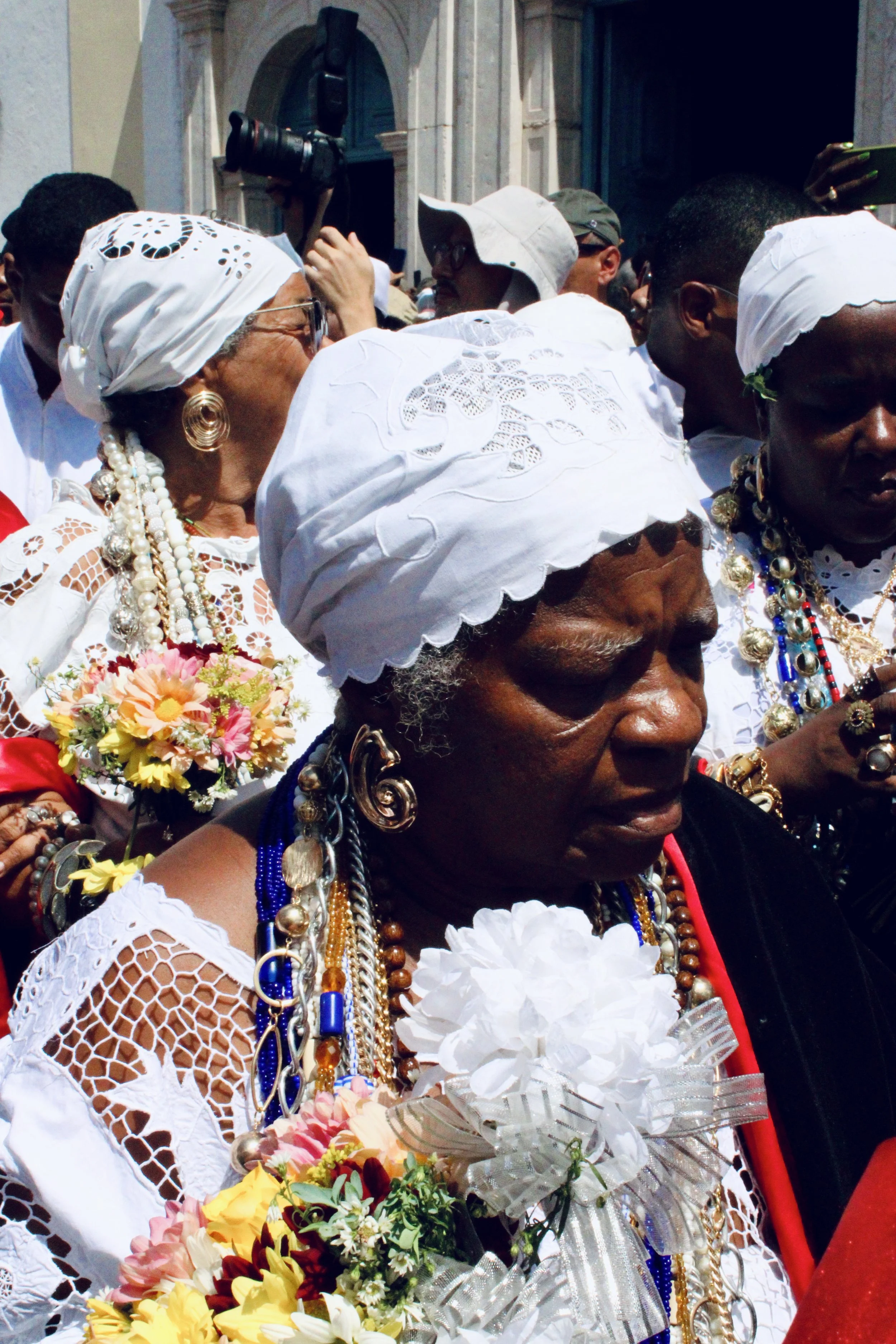
Irmã Floricea dos Santos Balbino after the Festive Day in honor of Our Lady of Glory, in front of the Igreja Matriz de Nossa Senhora do Rosário (the Parish Church of Our Lady of the Rosary) .August 15, 2026. Photo by Jaimee A. Swift.
Irmãs of Boa Morte before the procession of the bier of Our Lady of the Good Death to the Capela de Nossa Senhora da Ajuda (The Chapel of Our Lady of Help). August 13, 2026. Photo by Jaimee A. Swift.
As Irmãs (The Sisters) in front of the Cultural Center of the Sisterhood of Our Lady of the Good Death. August 14, 2026. Photo by Jaimee A. Swift.