
The Radical Feminist Imagination of Ama Ata Aidoo
Collage celebrating the power of Ama Ata Aidoo. Photo of Ama Ata Aidoo retrieved from The Guardian.
By Karla Méndez
Exploring the radical feminist imagination of Ama Ata Aidoo, whose stories of womanhood, freedom, and belonging reshaped African feminism.
“African women were feminists long before feminism. They had to be.”
Introduction
Born Chrsitina Ama Ata Aidoo on March 23rd, 1942, in the village of Abeadzi Kyiakor, Gold Coast (now Ghana), Ama Ata Aidoo emerged as one of Africa’s most incisive literary voices and feminist thinkers. Raised in the Fante traditions by a father who founded his village’s first school as Ghana approached independence in 1957, Aidoo’s journey from rural Ghana to global literary stages was underpinned by a belief in the power of storytelling, education, and women’s agency. The atmosphere of national awakening shaped her understanding of identity, culture, and power. As a young girl, she witnessed how colonial systems and patriarchal norms intertwined and how women often carried the labor of communities yet remained excluded from decision-making. These early experiences would define her literary and political activism.
Bridging Ghana and the World
Aidoo grew up among the Fanti people in a village where her father’s commitment to education offered her early access to ideas of literacy, learning and self-determination. His school in Abeadzi Kyiakor symbolized the possibility of knowledge rooted in local life. Her rural childhood sharpened her awareness of the intersections of tradition and modernity, of communal responsibility and individual voice. These early conditions framed her lifelong engagement with identity, culture, gender, and the legacies of colonialism.
She attended Wesley Girls’ High School in Cape Coat, where her passion for writing began to take form. She went on to earn a BA in English from the University of Ghana, Legon, 1964. As a student, she wrote and staged her first play, The Dilemma of a Ghost, a work that made her the first African American to have a play published internationally. Her education was both local and global. After graduating from high school, she went on to earn her BA from the University of Ghana, Legon in English in 1964 and her MA from Stanford in 1970 in English. Aidoo later returned to Ghana to teach at her alma mater where she also served as a research fellow at the Institute of African Studies, studying Fante oral drama. Her academic work allowed her to merge scholarly analysis with creative practice, grounding her literature in both cultural memory and lived experience.
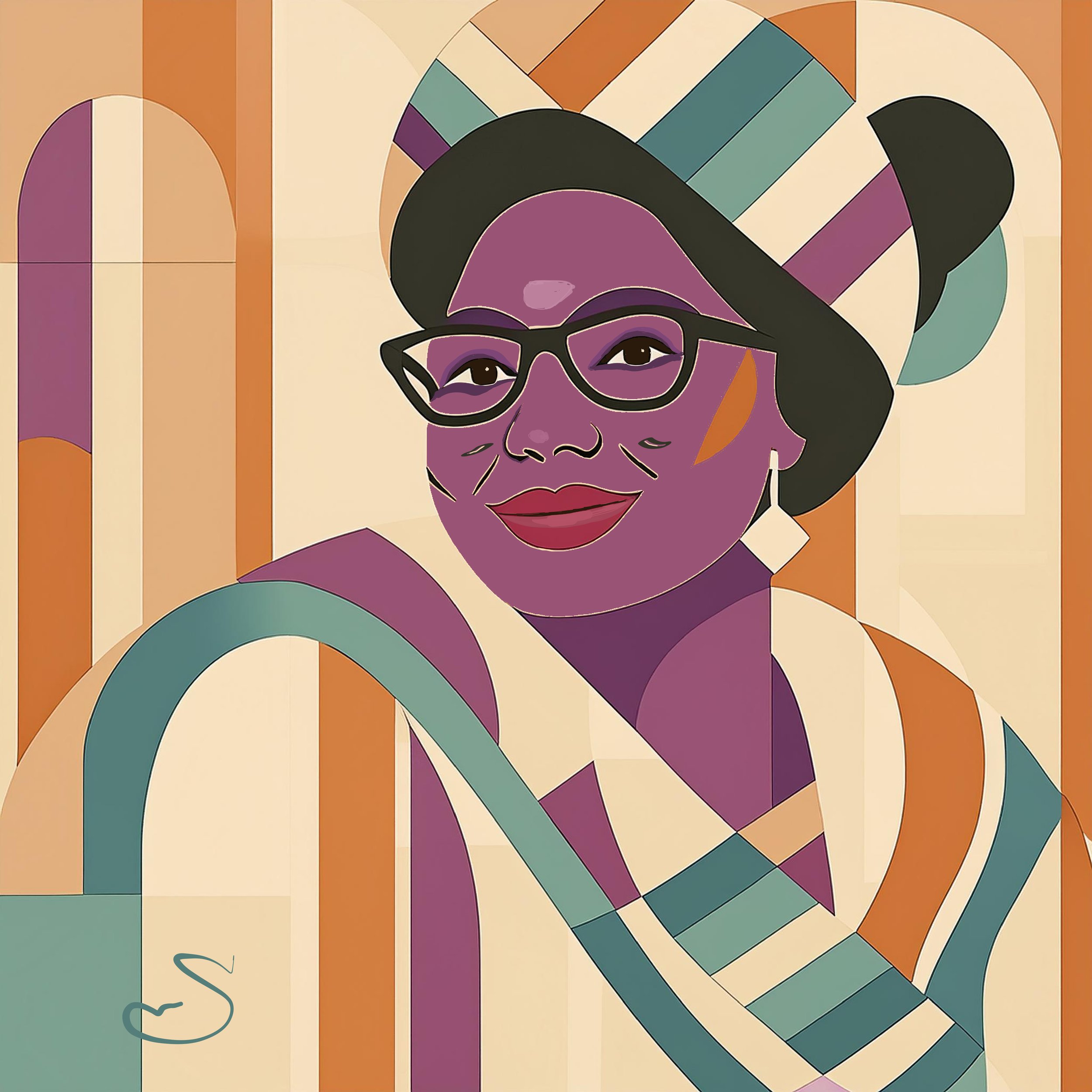
Artwork of Ama Ata Aidoo by Sedrick Miles.
Literary Work and Feminist Vision
Aidoo’s body of work spans novels, short stories, plays, poetry, and essays, with much of her work exploring themes of alienation, cultural hybridity, and gender expectations, exposing the dissonance between Western education and traditional African values. Her first play, The Dilemma of a Ghost (1964), tells the story of Ato, a Ghanaian man who returns home from studying abroad with his Black American wife, Eulalie. Her next major play, Anowa (1970), reimagines a Fanti legend about a woman who defies social conventions and refuses to conform to the expectations of wifehood. The play critiques patriarchy and slavery while offering a mediation on female anatomy and moral responsibility. Aidoo’s prose work No Sweetness Here (1970) expanded these themes through a series of short stories depicting women negotiating love, labor, and survival in post-independence Ghana.
In 1977, she published Our Sister Killjoy: Or Reflections from a Black-eyed Squint, a hybrid of prose, poetry, and political reflection. The book follows Sissie, a young Ghanaian woman traveling through Europe, as she confronts racism, alienation, and the contradictions of modern identity. With biting irony and lyricism, the novel dissects colonial mentalities that persist even in postcolonial societies.
Her 1991 novel Changes: A Love Story remains her most celebrated. It tells the story of Esi Sekyi, a career-driven Ghanaian woman who divorces her husband and enters into a polygamous marriage. The book questions the assumptions underlying marriage, modernity, and autonomy. Across these works, her feminism is evident, but as an organic extension of her cultural and political consciousness. As Aidoo once said, “African women were feminists long before feminism. They had to be.”
African Feminism vs. Western Feminism
Aidoo’s feminism was distinctly African. She rejected the idea that gender equality could be discussed apart from history, economics, and colonialism. In her view, feminism in Africa could not simply replicate Western models focused on individual liberation or legal equality. It had to address the communal structures, cultural continuity, and the intersection of patriarchy with imperialism that produced inequality.
Her characters are not merely fighting men; they are negotiating complex worlds shaped by colonial education, class and tradition. They challenge the notion that progress means rejecting culture. Instead, Aidoo’s women seek to redefine it. Her feminism emphasizes cooperation, storytelling, and cultural reclamation over confrontation, a framework many scholars now recognize as central to African feminist thought. Aidoo remarked in her 1998 essay “The African Woman Today” that she is a feminist, insisting that “every woman and every man should be a feminist.”
Beyond the Page: Educator, Activist, and Advocate
Aidoo’s activism extended beyond writing. In 1982, she was appointed Ghana’s Secretary for Education under Jerry Rawlings’ government, the first woman to hold the post. She resigned a year later as she was frustrated by the political constraints that prevented her from implementing changes. She later worked in Zimbabwe with the Ministry of Education’s Curriculum Development Unit and was active in the Zimbabwe Women Writers Group. In 2000, she co-founded the Mbaasem Foundation with her daughter Kinna Likimani, a nonprofit organization supporting Ghanaian and African women writers. Through education, mentorship, and advocacy, she advanced the cultural infrastructure necessary for African women’s literary production, a vision of feminism that was as practical as it was philosophical.
“Aidoo’s feminism was distinctly African. She rejected the idea that gender equality could be discussed apart from history, economics, and colonialism. In her view, feminism in Africa could not simply replicate Western models focused on individual liberation or legal equality. It had to address communal structures, cultural continuity, and the intersection of patriarchy with imperialism.”
Global Recognition and Legacy
Over her career, Aidoo received numerous awards, including the Mbaru Club Prize for her short story “No Sweetness Here” and the Commonwealth Writers’ Prize for Best Book in Africa in 1993, making her the first woman writer to be awarded the prize. She was awarded a Fulbright Scholarship in 1988 and served as a writer-in-residence at the University of Richmond in 1989. Her work has been translated into multiple languages and continues to be studied in literature, gender, and African studies programs worldwide. Scholars recognize her as part of the first generation of African women writers whose work redefined both African literature and feminist theory.
Aidoo passed away on May 31, 2023 at the age of 81, leaving behind a body of work that continues to challenge, provoke, and inspire. Her feminism was rooted in lived experience, shaped by the belief that liberation must begin in language and imagination. As she once said, “For us Africans, literature must serve a purpose: to expose, embarrass, and fight corruption and authoritarianism. It is understandable why the African artist is utilitarian.” Aidoo’s life reminds us that storytelling is an act of resistance, that to write is to imagine a freer world and to make it real.
About the author: Karla Méndez is an arts and culture writer whose work examines the histories of Black and Latin American women and their representations within visual art, literature, poetry, and performance. She is interested in how women put forth representations of themselves that are accurately representative of their expansiveness and how they use these avenues to engage with topics of identity, gender, race, and the female body. Ultimately, her work seeks to explore and reinstate forgotten and ignored histories as a site of care for ourselves and our communities.
She is the lead columnist of Black Feminist Histories and Social Movements, a column for the advocacy organization Black Women Radicals. She is a contributor for the Boston Art Review and Elephant Magazine and her work has appeared in the Brown Art Review and Ampersand: An American Studies Journal.