
Art for the People: Elizabeth Catlett’s Vision of Liberation
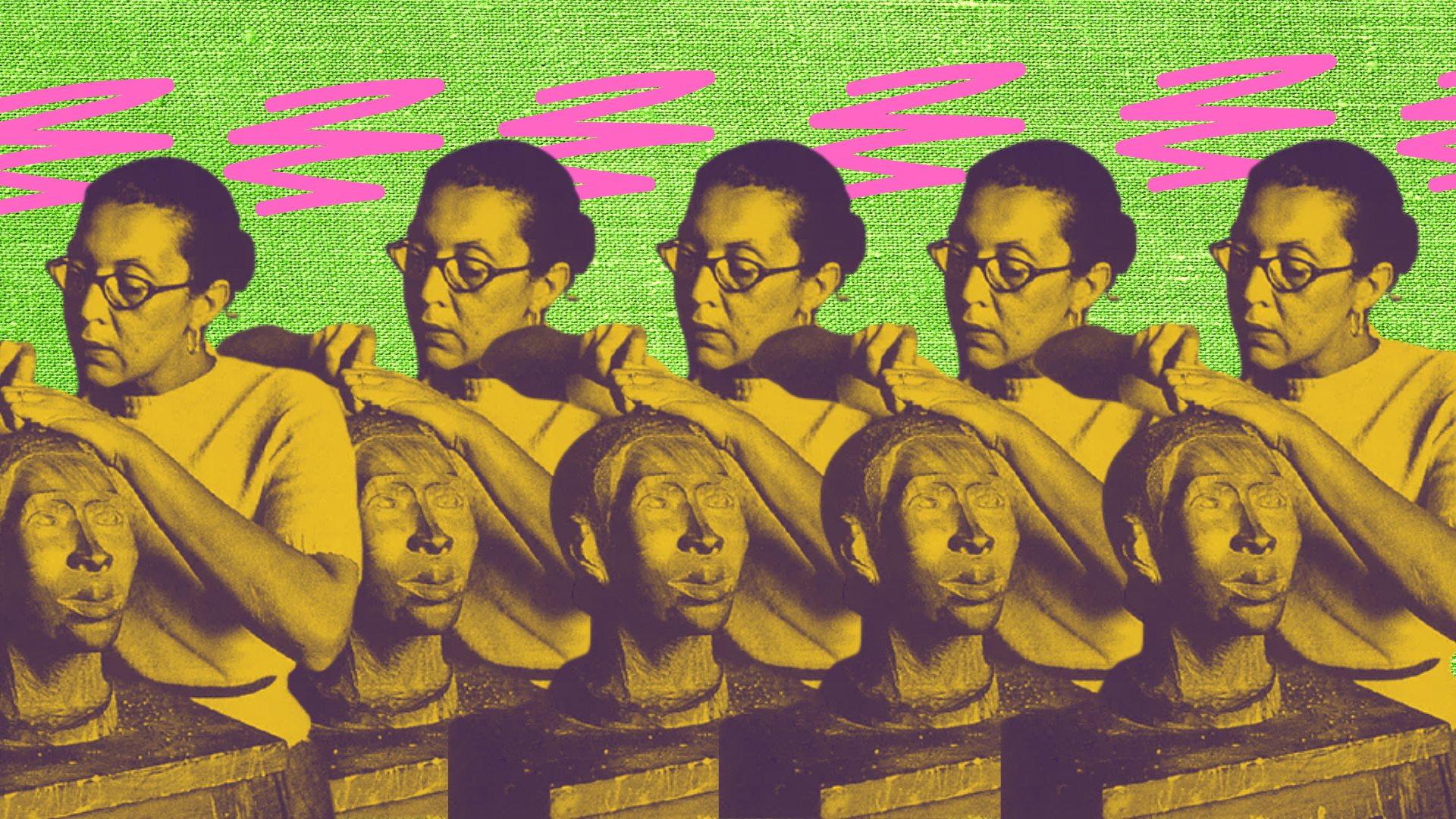
Collage honoring the work of Elizabeth Catlett. Photography of Elizabeth Catlett by Eric Minh Swenson. Photo retrieved from The Lantern Network.
By Karla Méndez
Reflecting on the life of Elizabeth Catlett, a pioneering sculptor and printmaker whose work fused art and activism to honor the strength, resilience, and dignity of Black women across the African diaspora.
Where Her Story Begins
Born Alice Elizabeth Catlett on April 15th, 1915, in Washington, D.C., she was raised listening to stories about plantation life and the theft of people from Africa. Both of her parents were the children of formerly enslaved people, something that inspired her work. Catlett’s work and lifelong commitment to social justice, equal rights, and political freedom was also in part fueled by her experiences during the Great Depression. As a teenager, she witnessed first hand the devastating impact it had on many in the United States, but specifically, Black Americans. As the economy began its descent downward, companies began cost-cutting initiatives, resulting in the loss of hours and jobs for Black Americans, following the practice of, “last hired, last fired.”
Black Americans experienced the highest level of unemployment in the 1930s, triple that of white Americans. Many found themselves fired and replaced with white Americans and by 1932, 50 percent of them were out of work. The Great Depression significantly hindered the economic growth of Black Americans, which not only impacted them for decades, but it also paved the way for the Civil Rights Movement. Witnessing this moment in history was her initiation to her lifelong commitment to fighting for the rights of Black Americans.
“Catlett’s work and lifelong commitment to social justice, equal rights, and political freedom was also in part fueled by her experiences during the Great Depression.”
Learning to Fight with Art
In 1933, Catlett began her studies at Howard University after being accepted to Carnegie Institute of Technology and subsequently having her offer rescinded due to her race. As a student, some of her professors included artists like Lois Mailou Wells and James Lesesne Wells, both associated with the Harlem Renaissance. Studying under professors who were associated with a movement concerned with celebrating the cultural and intellectual contributions of Black Americans influenced Catlett to fight for the rights of Black Americans through her work. She went on to graduate from Howard with honors in 1937. Though there were several women who had pursued art as a career, Catlett chose to become a teacher, moving to Durham, North Carolina to teach art at a local high school. As was common practice, she was paid significantly less than her white counterpart. This prompted her to participate in a campaign alongside Thurgood Marshall to gain equal pay for Black teachers, which was ultimately unsuccessful.
After a year of teaching, Catlett enrolled in the University of Iowa (UIOWA) after becoming interested in the work of Grant Wood. As a student, he became Catlett’s mentor. Though she was accepted to and attended the university, she still experienced discrimination. She was not permitted to live in university housing as it was closed off to Black American students until 1945, when Betty Jean Arnett desegregated a residency hall. She was forced to live in segregated off-campus housing, a reminder of the racism in educational institutions, even those that accepted Black students. In classes she was the only Black student and often felt invisible and unwelcome. In a 2013 interview with the University of Iowa Alumni Magazine, the artist reflected on her time there, sharing “I’d lived in African American culture my whole life. In Iowa City, I suddenly was living among white people, but I still couldn’t do things like live in the dorms.”
Wood would tell his students to paint what they knew and that’s exactly what Catlett did when creating her master’s thesis. She produced the limestone sculpture Mother and Child (1940) (also known as Negro Mother and Child, portraying and celebrating maternal strength and dignity. The piece stands as the beginning of her exploration of Black motherhood and social justice, themes that she continued to revisit throughout her career. As a Black woman, portraying the relationship between mother and child was both personal and political, as Catlett wrote in 1940, “The implications of motherhood, especially Negro motherhood, are quite important to me as I am a Negro as well as a woman.” The piece was awarded first prize in sculpture at the 1940 American Exposition, the same year she graduated from UIOWA, becoming one of the first three MFA graduates and the first Black American women to receive the degree.
A New Role, the Same Fight
Finished with her studies at UIOWA, she then moved to New Orleans to teach at the historical Black university, Dillard University. She would spend her summer breaks in Chicago, taking ceramics classes at the School of the Art Institute of Chicago and lithography classes at the South Side Community Center. Her experience teaching at Dillard mirrored her previous experiences in educational institutions. She served as the chair of the art department and in that role organized a field trip for her students to a Picasso exhibition at the New Orleans Museum of Art. Due to the Jim Crow laws of the 1940s that mandated the separation of Black and white individuals in public spaces, the main entrance to the museum was closed to Black Americans. She and her students were forced to enter directly from their bus, an all-too-common occurrence that highlighted the pervasive racial barriers.
During her first summer in Chicago, she met the artist Charles Wilber White, who she would go on to marry in 1941. After she was rejected for a Julius Rosenwald Fund Fellowship in 1943, three years later she was awarded the fellowship and moved to Mexico. She was influenced to accept the funding as she witnessed American art shifting to the abstract, which conflicted with her desire to create work that focused on social themes like injustices committed against Black women and the continuing fight for equal rights. In her application, she proposed utilizing the money she received to produce a “series of lithographs, paintings, and sculptures of Negro women in the fight for Democratic rights in the history of America.” The finished project, titled The Negro Woman (1946-1947), consists of 15 linoleum cuts depicting Black women and matriarchal figures like Harriet Tubman, Sojourner Truth, and anonymous women engaged in labor and activism, and their struggles, resiliency, and contributions. She wanted to challenge the prevalent stereotypes assigned to Black women, stating “Negro women in America have long suffered under the double handicap of race and sex. Because of subtle American propaganda in the movies, radio, and stage, they have come to be generally regarded as good cooks, housemaids and nurses and little else. At this time when we are fighting an all out war against tyranny and oppression, it is extremely important that the picture of Negro women…be sharply drawn.” The title of each print in the series emphasizes the narrative, like I Have Always Worked Hard in America (1946) and In Sojourner Truth I Fought for the Rights of Women as Well as Blacks (1946).
“Negro women in America have long suffered under the double handicap of race and sex. Because of subtle American propaganda in the movies, radio and stage, they have come to be generally regarded as good cooks, housemaids and nurses and little else. At this time when we are fighting an all out war against tyranny and oppression, it is extremely important that the picture of Negro women…be sharply drawn.”
Elizabeth Catlett, "I am the Negro Woman" (1947). Linocut on paper, 5 1/2 x 5 in. (13.97 x 12.7 cm.). Pennsylvania Academy of the Fine Arts. Wikimedia Commons. Creative Commons Attribution 4.0 International.
From Print to Praxis
Her relocation to Mexico City also provided her with the opportunity to join Taller de Gráfica Popular (TGP), a collective of artists founded in 1937 that was dedicated to utilizing art for social change. Catlett was involved with TGP from 1946 to 1966, marking a transformative period in her artistic and political practice. The collective was committed to creating art that served people, using printmaking as a tool for social change and to produce art to inspire action in others. TGP also provided a space for artists to collaborate and engage with political movements. During her time with TGP, she collaborated with other artists who, like her, were committed to using art as a tool. Though when she first joined, she created work that was expressly focused on highlighting the struggles and strength of Black American women, as she spent more time in Mexico, she began to see the interrelation between the experiences of Black Americans and Mexicans.
Catlett’s work focused on building a transnational solidarity between the U.S. and Mexico. She viewed struggles against racism, colonialism, and economic injustice as interconnected. Her work bridged the Black American and Indigenous Latin American experience, highlighting a shared struggle against oppression and advocating for solidarity across national and racial lines. In the linocut Sharecropper (1952), she depicts a Black woman with a broad-brimmed straw hat, a symbol of her labor and drawing parallels between Black American sharecroppers and Mexican campesinos, both of whom were subjected to exploitative labor systems. In another piece Alfabetización (1953), three women are engaged in a literacy lesson, wearing traditional rebozos, or a long flat garment, similar to a shawl and commonly worn by women in Mexico. As someone who continuously educated herself and others, she knew the importance of education and its use as a tool for empowerment, emphasizing that through this piece.
“Catlett’s work focused on building a transnational solidarity between the U.S. and Mexico. She viewed struggles against racism, colonialism, and economic injustice as interconnected. Her work bridged the Black American and Indigenous Latin American experience, highlighting a shared struggle against oppression and advocating for solidarity across national and racial lines.”
When Art Becomes a Threat
Some of the artists in TGP were also members of the Communist Party, and because of that and the collective’s fight for justice, Catlett came under surveillance by the U.S. Embassy in Mexico City in 1949. After being arrested during a Mexico City railroad workers’ strike, her activities and communications began to be monitored, resulting in denying her re-entry into the U.S. and declaring her an “undesirable alien.” After being labeled a “threat to the well-being of the United States” and renouncing her U.S. citizenship in 1962, she delivered an address in 1970 to the Conference on the Functional Aspects of Black Art (Confaba) after her visa was refused. She was ultimately allowed to return to the states for an exhibition of her work at the Studio Museum in Harlem in 1971 after a letter-writing campaign to the U.S. State Department.
After renouncing her citizenship, Catlett settled in Cuernavaca, Mexico with her husband Mexican artist Francisco Mora, whom she had married in 1947. She continued to make work that foregrounded the solidarity between Black and brown people, resulting in a blend of Black American histories with Latin American aesthetics and politics. Though she did produce prints and drawings, she turned more toward sculpture, primarily working in wood, clay, marble, and bronze. In these pieces, she again portrayed and examined maternal strength, quiet resistance, and elegance.
She also returned to teaching, becoming the first woman to be the head of the sculpture department at the Escuela Nacional de Artes Plásticas (National School of Plastic Arts) at the Universidad Nacional Autónoma de México (UNAM). She didn’t allow her barring from the U.S. to stop her from being politically engaged through her art, producing work like Homage to My Young Black Sisters (1968) which depicts the raised-fist figure of a young Black woman standing tall and proud, a reference to both the Black Power salute and feminist solidarity. This bronze sculpture also speaks to the intersectional existence of Black women, between race and gender. She also addressed state surveillance in Target (1970), in which a Black man is behind a crosshair, a commentary on the ways that Black bodies are criminalized and targeted by systems of power. It is also perhaps both a nod to her own surveillance and that of other activists during the time, such as the use of COINTELPRO by the FBI. Catlett regained her citizenship in 2002.
A Legacy Cast in Bronze and Resistance
In the 1990s and 2000s, Catlett and her work began to be recognized and honored, with her work entering major collections and retrospectives of her career being organized. She was awarded the Women’s Caucus for Art Lifetime Achievement Award in 1981 honoring her dedication to her creative practice and commitment to social justice and education. She also received the International Sculpture Center’s Lifetime Achievement Award in Contemporary Sculpture in 2003 which asserted her role in expanding the medium and received the Legion of Honor in Mexico in recognition of her cultural contributions to Mexican society.
Her legacy primarily lies in the ways she merged aesthetics with activism. Instead of visualizing and depicting Black life as tragedy, she presented the survival, resilience, and joy of Black Americans, specifically Black women. She was one of the first artists to depict Afrocentric features and working-class strength paving the way for future artists like Kara Walker, Simone Leigh, and Nona Faustine. Her work serves as a blueprint for artists and scholars who want to think and create beyond the nation-state. Like Catlett, they are interested in the development and embrace of diasporic identity and linking historical memory to collective resistance across the Americans and the Black Atlantic. For Catlett, art was never separate from life, it was a vehicle for reflection, empowerment, and transformation. As she once said, “I have always wanted my art to service my people - to reflect us, to relate to us, to stimulate us, to make us aware of our potential” (Footnote 1).
Footnotes
Richard J. Powell, Elizabeth Catlett: In the Image of the People (Hartford: Yale University Press, 2009).
About the author: Karla Méndez is an arts and culture writer whose work examines the histories of Black and Latin American women and their representations within visual art, literature, poetry, and performance. She is interested in how women put forth representations of themselves that are accurately representative of their expansiveness and how they use these avenues to engage with topics of identity, gender, race, and the female body. Ultimately, her work seeks to explore and reinstate forgotten and ignored histories as a site of care for ourselves and our communities.
She is the lead columnist of Black Feminist Histories and Social Movements, a column for the advocacy organization Black Women Radicals. She is a contributor for the Boston Art Review and Elephant Magazine and her work has appeared in the Brown Art Review and Ampersand: An American Studies Journal.